
I have been learning English for years, but I still can’t read every word (even without understanding the meaning).
My problem is that I don’t know te IPA. In English, there is no 1-to-1 relationship between letters and sounds. A single sound (phoneme) can often be represented by several different letter combinations (graphemes). For example: The long e /iː/ sound can be represented by e, ee, ea, ie, ei, or ey. Italian pronunciation is less complex than English. Here are some key points to help you pronounce Italian better.
1. Alphabet: The Italian alphabet contains 21 letters,
- 5 Vowels: A, E, I, O, U
- 16 Consonants: B, C, D, F, G, H, L, M, N, P, Q, R, S, T, V, Z
- The letters J, K, W, X, and Y are foreign letters
2. Italian IPA
There are some Italian sounds that do not exist in English, and we can find some sounds that are similar
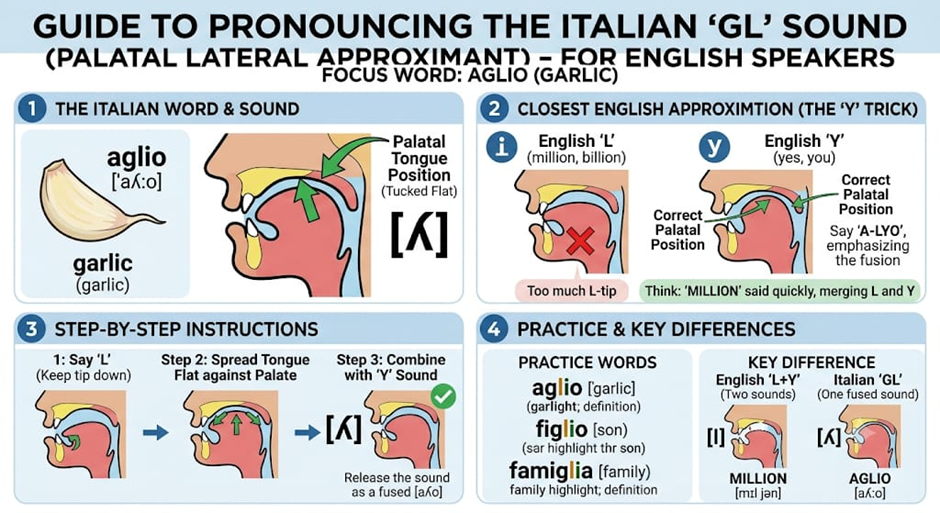
For example, in English we don’t have GL: /ʎ/ sound, so how to pronoun Italian GL: /ʎ/ sound? Try to keep position of /j/ in yes to say /l/ in leg.
Step 1: Say leg – /lɛg/, then say /l/, remember l position.
Step 2: Say yes- /jɛs/, then say /j/, remember /j/ position.
Step 3: Keep position of /j/ sound and say /l/. It sounds like /ʎ/
3. Syllables
Here are some Special and Complex Sound Groups in Italian
1. Soft and Hard Sounds (C and G)
- Hard sound (Suono duro):
CA,CO,CU,CHE,CHI/GA,GO,GU,GHE,GHI - Soft sound (Suono dolce):
CIA,CE,CI,CIO,CIU/GIA,GE,GI,GIO,GIU
2. Nasal and Palatal Groups (GN and GL)
- GN:
GNA,GNE,GNI,GNO,GNU(nasal sound) - GL:
GLA,GLE,GLI,GLO,GLU(plus the palatal sound:GLIA,GLIE,GLIO,GLIU)
3. The SC Group
- Hard sound (Suono duro):
SCA,SCO,SCU,SCHE,SCHI - Soft sound (Suono dolce):
SCIA,SCE,SCI,SCIO,SCIU
Leave a Reply